

La différence entre Tetsubin et kyusu réside dans leur fonction : un tetsubin est une bouilloire en fer utilisée pour chauffer l'eau, tandis qu'un kyusu est une théière conçue pour infuser le thé japonais en vrac.
La plupart des gens les confondent car ils se ressemblent extérieurement. Tous deux sont compacts, tous deux sont associés à la culture du thé japonaise et tous deux partagent souvent la même esthétique de fer noir.
Mais la distinction entre tetsubin et kyusu a une importance pratique : utiliser le mauvais risque d'endommager votre service à thé ou de produire une tasse plate et métallique qui passe complètement à côté du but.
Cet article explique en détail le fonctionnement de chaque récipient, sa fonction, son impact sur l'eau et le thé, et lequel convient le mieux aux différentes habitudes d'infusion.
Si vous possédez déjà une théière kyusu et souhaitez explorer le vaste univers des théières japonaises, le guide Nio Teas sur les théières japonaises couvre chaque style en détail.
Commençons !
Tetsubin contre Kyusu : L'un chauffe l'eau, l'autre prépare le thé

La différence entre le tetsubin et kyusu se résume à une simple distinction fonctionnelle : le tetsubin est une bouilloire en fer servant à faire bouillir et à conserver l’eau, tandis que le kyusu est une théière en terre cuite ou en fer servant à infuser le thé. Confondre l’un avec l’autre pose de réels problèmes.
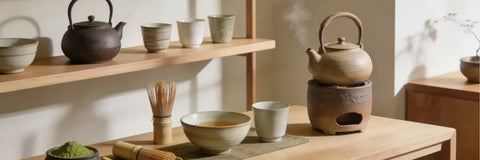
Un tetsubin traditionnel possède un intérieur en fer non revêtu. Cette surface en fer brut est sans danger pour l'eau bouillante et peut même être placée sur une flamme nue ou un brûleur à gaz. Il ne faut jamais ajouter les feuilles de thé directement dans un tetsubin , car le fer pourrait réagir avec les composés du thé, notamment les tanins, et produire un goût âpre et astringent. Le tetsubin est le récipient de stockage, et non celui d'infusion.
Le kyusu , en revanche, est conçu spécifiquement pour l'infusion, et ce n'est pas le seul récipient à infusion japonais compact qui mérite d'être connu ; si vous souhaitez savoir comment il se compare à d'autres modèles, la comparaison entre le shiboridashi et kyusu est une lecture utile. Son intérieur est soit en terre cuite non émaillée, qui absorbe et développe les huiles du thé au fil du temps, soit en fer émaillé dans le cas d'une théière en fonte utilisée pour l'infusion. Il est muni d'un filtre intégré pour retenir les particules de feuilles et d'une poignée latérale qui reste froide lors du service. Il ne doit jamais être placé sur une source de chaleur directe.
Comment fonctionne un Tetsubin et à quoi sert-il réellement ?
Le rôle du Tetsubin dans la préparation de l'eau
Comprendre la différence entre tetsubin et kyusu commence par l'étude du tetsubin lui-même. Son rôle est de faire bouillir et de conditionner l'eau avant qu'elle n'atteigne votre récipient d'infusion. L'intérieur en fer brut réagit lentement avec les minéraux présents dans l'eau pendant la chauffe, ce qui, de l'avis de nombreux amateurs de thé, produit un thé nettement plus doux et rond que celui obtenu avec de l'eau bouillie dans de l'acier inoxydable ou du verre.
Cet effet est particulièrement pertinent si vous utilisez une eau dure. Le fer peut contribuer à neutraliser l'âpreté que l'eau dure confère au thé vert, ce qui en fait un atout précieux si votre eau du robinet est riche en minéraux et que vous constatez une altération du goût de thés délicats comme gyokuro ou sencha .
Que se passe-t-il si vous infusez du thé directement dans un Tetsubin

Si vous mettez directement des feuilles de thé dans un tetsubin et les laissez infuser, le fer non revêtu réagira avec les catéchines et les tanins contenus dans les feuilles. Il en résultera un goût métallique et amer qui altérera la douceur naturelle et l'umami d'un thé japonais de qualité. Le tetsubin n'est tout simplement pas conçu pour ce contact.
Il y a aussi un problème d'entretien. Les résidus de thé au contact du fer brut accélèrent la rouille. Même une courte infusion peut laisser un film difficile à enlever, ce qui réduira considérablement la durée de vie de la bouilloire.
Comment une théière Kyusu infuse le thé et pourquoi son design est important
Kyusu en argile contre Kyusu en fonte : Matériaux différents, même usage
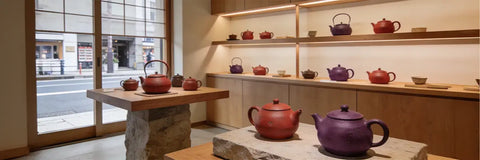
La théière kyusu traditionnelle est fabriquée en argile, le plus souvent en argile rouge riche en fer provenant de Tokoname , dans la préfecture Aichi . Il existe cependant des modèles kyusu porcelaine pour ceux qui préfèrent une surface neutre n'absorbant pas les huiles du thé entre les infusions. Cette argile est prisée pour sa faible porosité et sa capacité à absorber les huiles du thé au fil des centaines d'infusions, développant ainsi progressivement une surface qui adoucit l'amertume et intensifie les arômes à chaque utilisation.
Un kyusu en fonte ressemble à un tetsubin , mais fonctionne comme un pot en terre cuite. Son intérieur est émaillé, ce qui imperméabilise le fer et le rend apte à l'infusion du thé. L'émail empêche le fer de réagir avec les tanins du thé, ce qui permet de bénéficier des propriétés de rétention de chaleur du fer sans les inconvénients liés au contact avec le métal. Du fait de son revêtement émaillé, un kyusu en fonte ne doit jamais être exposé à une source de chaleur directe ; l'émail risquerait de se fissurer.
Le filtre intégré et la poignée latérale ne sont pas d'ordre esthétique.
Chaque kyusu de qualité possède un filtre intégré à la base du bec. Sur les modèles en terre cuite, il s'agit souvent d'une fine grille perforée directement dans la théière lors de sa fabrication. Sur d'autres, c'est une grille en acier inoxydable. Le filtre retient les particules de feuilles de thé et permet de verser le thé entièrement après chaque infusion, interrompant ainsi l'infusion avant que les feuilles ne soient trop infusées et ne deviennent amères.
La poignée latérale creuse est tout aussi fonctionnelle ; c’est la caractéristique principale duyokode kyusu , le modèle à poignée latérale le plus couramment utilisé pour la préparation du thé vert japonais. Grâce à la circulation de l’air dans le canal creux, la poignée reste froide même lorsque la théière est remplie d’eau presque bouillante. Cela permet de verser le thé d’un simple mouvement de poignet, sans avoir à serrer la théière, ce qui assure un versement plus régulier et plus précis et évite de remuer les feuilles pendant l’infusion.
Tetsubin contre Kyusu : Comment chaque récipient influence le goût de votre thé

Effets de l'ébullition de l'eau dans un Tetsubin sur la saveur
L'eau bouillie dans une bouilloire traditionnelle en fonte se charge de traces de fer, qui réagissent avec les minéraux présents dans l'eau lors du chauffage. La plupart des amateurs de thé expérimentés décrivent le résultat comme étant nettement plus doux, avec une rondeur légèrement sucrée, comparé à l'eau bouillie dans une bouilloire en acier inoxydable. La différence est subtile, mais elle est souvent perçue comme plus douce et plus ronde.
C’est pourquoi certains amateurs sencha et gyokuro privilégient une tetsubin comme source d’eau principale, même pour l’infusion dans un kyusu en terre cuite. Si sencha est votre thé de prédilection, le guide de Nio Teas sur l’infusionsencha kyusu explique comment choisir le récipient et les paramètres adaptés à cette méthode. La bouilloire conditionne l’eau ; le kyusu permet ensuite d’extraire le thé.
Ce que la Kyusu apporte à l'extraction que les autres théières n'apportent pas
La base large et arrondie du kyusu permet aux feuilles de thé de se déployer pleinement et d'absorber l'eau. C'est plus important qu'on ne le croit. Les feuilles comprimées dans une petite boule à thé ou un panier ne peuvent pas se déployer correctement, ce qui limite la surface de contact avec l'eau chaude et produit une infusion plus légère et moins complexe.
L'argile non émaillée Tokoname interagit également avec le thé lors de l'infusion. Légèrement alcaline, elle contribue à atténuer l'astringence des thés verts de haute qualité. Au fil des infusions, l'argile absorbe les huiles essentielles du thé, ce qui accentue cet effet. Un kyusu bien culotté peut ainsi rendre un même thé plus doux et équilibré au fil du temps.
Facilité d'utilisation et aspect pratique au quotidien
Lequel est le plus facile à entretenir au quotidien
L'entretien d'une théière kyusu en terre cuite est simple. Rincez-la à l'eau tiède après chaque utilisation, laissez-la sécher complètement à l'air libre, couvercle ouvert, et évitez le savon, qui peut être absorbé par la terre cuite non émaillée et laisser des résidus altérant le goût. Aucun outil ni procédure particulière n'est nécessaire. Pour des conseils d'entretien plus approfondis, Nio Teas propose une ressource dédiée. 👉 Comment nettoyer une Théière kyusu
Une bouilloire traditionnelle tetsubin demande un peu plus d'attention. Après chaque utilisation, il faut la vider complètement et la laisser sécher dans un endroit chaud avant de la ranger. Même une petite quantité d'eau résiduelle finira par provoquer de la rouille. Si de la rouille apparaît à l'intérieur, ce n'est pas dangereux, mais cela modifie le goût de l'eau et nécessite un nouveau culottage. Une bouilloire en fonte kyusu , grâce à son revêtement en émail, est plus facile d'entretien : rincer, sécher, et c'est tout.
Taille, capacité et destinataires de chaque navire
Une théière kyusu pour une ou deux personnes contient généralement entre 200 et 300 ml, une contenance adaptée aux portions concentrées utilisées pour les thés verts japonais de qualité supérieure. Pour une infusion individuelle de sencha ou gyokuro , on utilise généralement 150 ml d'eau et 5 grammes de feuilles. La théière Tokoname Kyusu Fukamushi est conçue selon ces proportions, avec un filtre à mailles fines spécialement adapté à la méthode de cuisson à la vapeur fukamushi . Son faible volume est intentionnel : il garantit un dosage précis et une saveur intense.
Le tetsubin est plus grand et plus lourd, conçu pour faire bouillir un volume d'eau conséquent plutôt que pour infuser une seule portion. Il n'est pas adapté au tetsubin rapide et kyusu qui rend le kyusu si pratique. En termes de praticité au quotidien, le kyusu l'emporte par sa facilité d'utilisation et sa précision. Le tetsubin trouve sa place comme conditionneur d'eau, et non comme solution de facilité pour l'infusion.
Lequel a sa place dans votre service à thé ?
La question tetsubin ou kyusu ne se résume pas à choisir entre deux alternatives. Ils servent à différentes étapes d'un même processus. Pour bien infuser le thé japonais en vrac, le kyusu est l'outil principal : il est spécialement conçu pour l'extraction, la gestion de la température et un versement précis.
Un tetsubin est un atout précieux si vous accordez une grande importance à la qualité de l'eau et à l'infusion de thés sensibles à la minéralisation. Utilisé comme source d'eau, il la conditionne avant qu'elle n'atteigne le kyusu et permet d'obtenir une infusion nettement plus douce avec les thés de qualité supérieure. Utilisé comme objet de décoration ou comme simple substitut à une théière, il n'excelle dans aucun de ces rôles.
Si vous êtes novice en matière de thé japonais en vrac, le choix entre tetsubin et kyusu est simple : commencez par le kyusu . Et si vous hésitez entre plusieurs méthodes d’infusion, la comparaison entre gaiwan et kyusu vaut la peine d’être lue avant de vous décider.
La collection de théières kyusu de Tokoname de Nio Teas propose des modèles pour les amateurs débutants comme pour les connaisseurs, avec des modèles à glaçure rouge pour plus de polyvalence et des modèles en terre cuite noire pour ceux qui privilégient un seul type de thé. Une fois votre technique d'infusion maîtrisée, un tetsubin s'avère un ajout intéressant, non pas pour le thé lui-même, mais pour la qualité de l'eau qu'il produit.

Commentaires (0)
Il n'y a pas de commentaires pour cet article. Soyez le premier à laisser un message !